
Category

Suv

Category

For many parents, the family SUV is the command center of daily life. It is the shuttle for soccer practice, the pack-mule for grocery hauls, and the sanctuary during a rainy school pickup. Because we rely so heavily on these vehicles to keep our schedules on track, the maintenance light on the dashboard can feel like an unwelcome guest. When you finally pull in for service and the technician asks, “Would you like synthetic or conventional oil today?” it can be hard to know which choice is truly best for your vehicle-and your budget.

In the past, the choice was simpler, but modern SUV engines have become more sophisticated, often featuring turbochargers and advanced fuel-saving technologies. To help you make an informed decision at your next oil change for SUVs, here are five essential things every owner should know about the difference between synthetic and conventional oil.

1. Synthetic Oil is “Engine Insurance” in Extreme Weather

If you live in a climate that swings from blistering summer heat to freezing winter mornings, synthetic oil is your engine’s best friend. Conventional oil is refined from crude oil, meaning it contains natural impurities that cause it to thicken like molasses in the cold and thin out like water in the heat.

Synthetic oil, however, is chemically engineered in a lab to be uniform. On a 10-degree morning when you are trying to get the kids to school, synthetic oil flows instantly to the top of the engine to lubricate moving parts. In the summer heat, it resists breaking down, ensuring your engine doesn’t overheat during a long idling session in the carpool line.

2. The Truth About the “Price Tag” vs. Value

It is no secret that a synthetic oil change costs more upfront than a conventional one-often nearly double. For a household managing a tight budget, this can be a deterrent. However, the “per mile” cost tells a different story.

Conventional oil typically needs to be changed every 3,000 to 5,000 miles. Synthetic oil is much more durable, often lasting 7,500 to 10,000 miles (depending on your vehicle’s manufacturer recommendations). For a busy mom, this means fewer trips to the shop and less time spent in a waiting room. Over the course of a year, the cost usually levels out, and the time saved is a massive bonus for any parent.

3. Better Protection for Turbocharged Engines

Many modern SUVs, even the smaller “crossover” models, now use turbocharged engines to provide more power while using less gas. These turbochargers spin at incredibly high speeds and generate intense heat.

Conventional oil can actually “cook” inside a hot turbocharger when you turn the engine off, creating a charcoal-like sludge that can eventually cause engine failure. Synthetic oil is designed specifically to handle these extreme temperatures. If your SUV has a “Turbo” badge on the back or a small engine that punches above its weight class, synthetic oil isn’t just an upgrade-it is often a requirement to keep your warranty valid.

4. Cleaning Power and Sludge Prevention

As an engine ages, it naturally develops “sludge”-a gooey buildup of old oil, carbon, and moisture. This sludge acts like cholesterol in an artery, slowing down the flow of oil and forcing the engine to work harder.

Synthetic oils contain advanced detergent additives that act like a deep-clean for your engine’s internals. They help dissolve existing deposits and prevent new ones from forming. If you are planning on keeping your family SUV for several years or want to pass it down to a teenage driver in the future, using synthetic oil is one of the most effective ways to ensure the engine remains “healthy” into high mileage.

5. Improved Fuel Economy for the Family Budget

Every time you fill up the gas tank, you are feeling the impact of your engine’s efficiency. Because synthetic oil is more slippery and consistent than conventional oil, it reduces “internal friction.” When the engine parts slide past each other more easily, the engine doesn’t have to burn as much fuel to move the car.

While the increase in miles-per-gallon might seem small-often just 1% to 2%-it adds up significantly over thousands of miles of driving. For a family that spends a lot of time on the road, these small efficiencies contribute to a more economical household.

So, which should you choose? If you drive an older SUV (model year 2010 or earlier) and you are very diligent about 3,000-mile service intervals, conventional oil may serve you just fine.

However, for the modern parent driving a newer vehicle, navigating extreme temperatures, or simply looking to minimize the number of times they have to visit a mechanic, synthetic oil is the clear winner. It offers superior protection for your most important investment and provides the peace of mind that your “command center” will be ready to go, no matter what the day throws at you. When it comes to family safety and vehicle longevity, sometimes the premium choice is actually the most practical one.
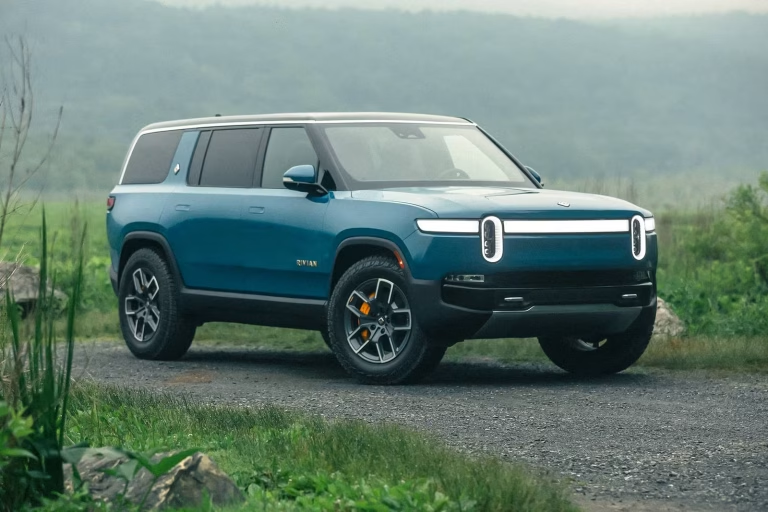
If you’re wondering how much does a rivian suv cost in 2026, the updated R1S lineup begins at $75,900 for the Adventure Dual-Motor Standard pack. The mid-tier Tri-Motor Max configuration sits around $105,900, while the flagship Quad-Motor (boasting 1,025 hp) reaches $115,900. Rivian has also introduced the more affordable, compact R2 SUV, which is now available for pre-order starting at approximately $45,000, aiming to bring the brand’s rugged EV aesthetic to a much wider audience.

Pricing has actually come down significantly since the R1S launched. Early buyers paid close to $95,000 for configurations that now cost $20,000 less – Rivian has been actively working to improve manufacturing efficiency and bring prices to a broader market. A federal EV tax credit of up to $7,500 may also apply depending on buyer income and the specific configuration chosen.

2025 Rivian R1S Pricing by Configuration

Trim / Config Battery Pack Est. Range Starting Price Key Difference
Dual-Motor Standard Standard Pack ~270 miles $75,900 Entry point; solid performance
Dual-Motor Large Large Pack ~352 miles $85,900 Best range-to-price ratio
Dual-Motor Max Max Pack ~410 miles $95,900 Maximum range; long-distance focus
Quad-Motor Large Large Pack ~321 miles $95,900 Performance upgrade; faster 0-60
Quad-Motor Max Max Pack ~390 miles $109,900 Flagship; top performance and range

Battery Pack Comparison

Battery Capacity Est. Range Charging (DC Fast) Best For
Standard Pack ~135 kWh ~270 miles ~140 kW peak Value buyers; shorter daily drives
Large Pack ~157 kWh ~352 miles ~216 kW peak Most buyers; best all-around choice
Max Pack ~180 kWh ~410 miles ~216 kW peak Long-distance travelers; range-anxious buyers

What’s Standard vs What Costs Extra

Feature Standard? Optional / Package
Three-row seating Yes – all R1S Standard; 7-seat configuration
Dual-motor AWD (base) Yes Quad-motor available as upgrade
12.3-inch driver display Yes Standard across all trims
Air suspension Yes Standard – adjustable height for off-road
360-degree camera system Yes Standard
Max Pack battery upgrade No Priced per pack selection
Adventure Package No Adds underbody protection, all-terrain tires
Max Pack + Quad-Motor No Only available together in flagship config

Rivian R1S vs Competitors

Vehicle Starting Price Range Seats 0-60 mph
Rivian R1S $75,900 270-410 miles 7 3.0-4.5 sec (config dependent)
Tesla Model X $79,990 335 miles 5-7 3.9 sec
GMC Hummer EV SUV $105,595 314 miles 5 ~3.5 sec
Cadillac Escalade IQ $130,000 450 miles 7 4.9 sec
Mercedes EQS SUV $104,400 305 miles 7 4.6 sec
Kia EV9 $54,900 304 miles 7 5.3 sec

Federal EV Tax Credit Eligibility

The Rivian R1S may qualify for the federal EV tax credit of up to $7,500 under the Inflation Reduction Act, subject to income limits and MSRP caps. For SUVs, the current MSRP cap is $80,000 – meaning only the base Dual-Motor Standard configuration falls under this threshold. Buyers should verify current eligibility at fueleconomy.gov/feg/taxevb.shtml before purchasing, as rules are subject to change.

Total Cost of Ownership Estimate

Cost Category Annual Estimate Notes
Electricity (charging at home) $600-$1,200 Based on 12,000 miles/year at avg US electricity rates
Insurance $2,500-$4,500 Higher than average due to vehicle value
Maintenance $400-$800 No oil changes; brake wear lower due to regen
Depreciation (Year 1) ~15-20% EV depreciation varies; Rivian holding value reasonably
Roadside / Software updates Included Rivian provides OTA updates and roadside assistance

Is the Rivian R1S Worth the Price?

For buyers who want a genuine full-size electric SUV with actual off-road capability and premium execution, the R1S is one of the most compelling options on the market. It does things no other EV SUV does – the gear tunnel storage, the wading capability, the Camp Mode that turns the truck into a power source – while also being a genuinely refined daily driver.

The main hesitation points are Rivian’s relative newness as a manufacturer and the service network which, while improving, still lags behind Tesla and traditional automakers. If you’re in a market with good Rivian service access and want something genuinely different, the R1S earns its price tag.

SUV City Survival: Mastering the Urban Jungle

The modern city street is a vibrant, often chaotic ecosystem. And increasingly, the SUV has become a prominent species within it. Once seen purely as rugged off-roaders or sprawling family haulers, SUVs now dominate sales charts, finding their way into dense urban centers where parking is a myth and traffic is a way of life. Many might scoff, questioning the logic of piloting a substantial vehicle through tight avenues, but the reality is, SUVs offer compelling advantages for city dwellers – if you know how to leverage them. This isn’t about *whether* an SUV belongs in the city, but *how* to truly master the urban jungle from behind its wheel.

Elevate Your Perspective: The Unsung Advantage of Height

One of the most immediate and impactful benefits of driving an SUV in the city is the elevated seating position. It’s not just about feeling taller; it’s about seeing more. From a higher vantage point, you gain a panoramic view of the road ahead, peering over the roofs of sedans and hatchbacks. This expanded field of vision allows you to anticipate traffic flow changes, spot merging vehicles earlier, and, crucially, identify pedestrians or cyclists who might otherwise be obscured by parked cars or larger vehicles. This proactive awareness is invaluable in avoiding last-second reactions and navigating congested intersections with greater confidence. It transforms a potential blind spot into a strategic advantage, especially when navigating busy school zones or bustling downtown areas.

The Parking Predicament: Outsmarting the Squeeze

Let’s be honest: parking an SUV in a crowded city can feel like trying to thread a needle with a rope. It’s the number one complaint, and for good reason. However, modern SUVs, coupled with smart driving habits, make this less of a nightmare and more of a manageable challenge.

* **Know Your Dimensions:** Before you even attempt that tight parallel spot, understand your vehicle’s exact length and width. Practice in an empty lot if you’re new to the vehicle.
* **Leverage Technology:** This is where today’s SUVs shine. Rearview cameras are standard, but look for models with 360-degree bird’s-eye views, front parking sensors, and even automated parking assist features. These systems turn guesswork into precision. Rear cross-traffic alert is also a lifesaver when backing out of a tight spot with limited visibility.
* **Think Small (Relatively):** If your primary driving is urban, consider a compact or mid-size SUV. Models like the Honda HR-V, Mazda CX-30, or Hyundai Kona offer SUV benefits in a more city-friendly footprint.
* **Plan Ahead:** Use navigation apps that show parking garage availability or street parking density. A few minutes of planning can

City SUV Showdown: Which Reigns Supreme?

The urban landscape has evolved, and so has our choice of wheels. Gone are the days when a sedan was the default city cruiser or a massive SUV solely for off-road adventures. Today, the city SUV segment is a bustling marketplace, teeming with options that promise the best of both worlds: compact agility for congested streets and the versatile utility we crave. But with so many contenders, how do you pick a winner? The truth is, “supreme” isn’t a universal title; it’s a crown custom-fitted to your specific urban lifestyle.

We’re not talking about head-to-head spec sheets of two models. Instead, let’s break down the distinct archetypes battling for supremacy in the concrete jungle, and figure out which one truly reigns for *you*.

The Agile Urban Sprinter: Mastering Tight Spaces

For many city dwellers, the ultimate challenge isn’t speed, but parking. Navigating narrow alleys, squeezing into compact spaces, and executing quick U-turns are daily rituals. This is where the truly agile urban sprinter shines. These are the smallest of the city SUVs, often built on car platforms, prioritizing maneuverability and fuel efficiency above all else. Think of them as elevated hatchbacks, offering a slightly higher driving position without the bulk.

Their compact footprint makes them incredibly easy to pilot through dense traffic and a breeze to park. Fuel economy is typically excellent, a crucial factor when gas prices fluctuate wildly. While cargo space might be modest, it’s usually more versatile than a traditional sedan, with fold-flat rear seats ready for an impromptu trip to the furniture store or a weekend escape. If your commute is a daily dance

City SUV: Small Footprint, Big Adventures

The urban landscape demands a lot from a vehicle. Navigating bustling streets, squeezing into tight parking spots, and dealing with stop-and-go traffic can make even a short commute feel like an epic journey. For years, city dwellers faced a dilemma: either opt for a compact car that excels in maneuverability but often sacrifices cargo space and a commanding view, or choose a larger SUV that offers comfort and capability but can feel cumbersome in the concrete jungle. But what if there was a perfect middle ground? Enter the City SUV – a vehicle engineered to conquer the urban sprawl while secretly harboring a spirit for the open road and weekend escapades.

The Urban Contradiction Solved

Modern life in the city is a constant balancing act. You need something practical for daily errands, reliable for the commute, and unobtrusive in a world where space is a premium. The City SUV, often a compact crossover, is precisely designed to meet these seemingly contradictory demands. It’s not just a smaller version of a full-size SUV; it’s a re-imagination of urban utility.

Nimble in the Concrete Jungle

Think about parallel parking on a busy street or making a quick U-turn in a tight lane. This is where the City SUV truly shines. Its shorter wheelbase and optimized steering geometry translate into impressive agility. You get the benefit of a higher driving position, offering better visibility over traffic, without the bulk that makes larger vehicles a chore to pilot. Many models boast an incredibly tight turning radius, allowing you to navigate congested areas with a confidence usually reserved for much smaller cars. It’s about feeling in control, even when the city tries to throw you off your game.

Parking Predicament No More

Perhaps the most immediate benefit of a City SUV’s smaller footprint is the sheer ease of parking. Whether it’s a parallel spot, a multi-story car park, or just a crowded grocery store lot, the compact dimensions make finding and fitting into spaces far less stressful. Features like rearview cameras, parking sensors, and even automated parking assist systems, which are increasingly standard, turn what was once a dreaded chore into a seamless experience. You spend less time circling the block and more time doing what you need to do.

Beyond the Pavement: Your Weekend Warrior

Just because a vehicle excels in the city doesn’t mean it should be confined there. The appeal of the City SUV lies in its dual personality. When Friday afternoon rolls around, and the urge for adventure strikes, this vehicle is ready to shed its urban skin and embrace the wilder side of life.

Gear Up and Go

The “SUV” in City SUV isn’t just for show. These vehicles are surprisingly versatile when it comes to hauling gear. Fold-flat rear seats often create a cavernous cargo area, perfect for mountain bikes, camping equipment, paddleboards, or a trunk full of luggage for a family road trip. Many models also come with sturdy roof rails as standard or optional, expanding your carrying capacity even further. Need to transport a bulky antique find or a week’s worth of groceries? No problem. The flexible interior design means you’re not limited by your vehicle’s exterior dimensions.

Confident Escapes

While not built for extreme off-roading, a City SUV offers a level of capability that far surpasses a typical sedan

City SUV Showdown: Which Reigns Supreme?

The urban landscape has become the new frontier for SUVs. Gone are the days when these vehicles were solely relegated to muddy trails or vast open highways. Today, the “Sport Utility Vehicle” has evolved into a chameleon, perfectly adapting to the concrete jungle. But with so many options crowding city showrooms, all promising the ideal blend of utility and urban agility, how do you truly pick a winner? The truth is, there isn’t one universal champion. Instead, the ultimate city SUV reigns supreme only when it perfectly aligns with *your* specific urban lifestyle and priorities.

Let’s cut through the marketing noise and look at two distinct profiles of city SUVs and the drivers they serve best. We’re not talking specific models, but rather the archetypes that dominate our city streets.

The Nimble Urbanite: Mastering the Concrete Jungle

First, consider the ultra-compact SUV. These are the true specialists, designed from the ground up to conquer tight spaces and navigate dense traffic with grace. Think of them as the automotive equivalent of a well-trained city bike – quick, responsive, and incredibly easy to maneuver. Their calling card is their small footprint, often barely larger than a compact sedan, making parallel parking feel less like a competitive sport and more like a casual task.

Who is This For?

This category is ideal for singles, couples without children, or empty-nesters who spend the vast majority of their driving time within city limits. Their daily commute involves stop-and-go traffic, frequent parking in crowded lots or on narrow streets, and occasional trips to the grocery store or a weekend escape. They prioritize ease of use and fuel efficiency over hauling capacity or rugged off-road prowess.

* **Parking Prowess:** Slipping into spots others pass by is a superpower.
* **Fuel Economy:** Smaller engines and lighter builds mean less pain at the pump, especially in city driving cycles.
* **Agility:** A tight turning radius makes U-turns and navigating congested intersections a breeze.
* **Budget-Friendly:** Often come with a more accessible price tag, both upfront and in terms of running costs.

The trade-off, of course, is cargo and passenger space. While surprisingly clever with their interior packaging, you won’t be moving furniture or comfortably seating five adults for a road trip. But for many urban dwellers, these compromises are entirely acceptable for the daily convenience gained.

The Versatile City-Dweller: Blending Urban Agility with Practicality

Then there’s the slightly larger, more versatile urban SUV. These vehicles bridge the gap between pure city agility and broader family or activity needs. They’ve grown a bit, offering more interior volume and often a more substantial feel, yet they retain enough urban sensibility to not feel like an oversized burden in city traffic. They are the generalists, designed to handle the city during the week and escape it with more comfort and cargo on the weekends.

Why Consider the Mid-